Padel vs. Pickleball: Rules, Equipment, and Play
Understanding the key differences between the two will help you to choose the right game that suits your style and interests.

Padel and pickleball are two racket sports that have gained immense popularity in recent years, offering fun, fast-paced gameplay for players of all skill levels. While both sports are often played in doubles and share similarities in court size and format, they have distinct differences in rules, equipment, and style of play.
No matter if you prefer the intense rallies of padel or the finesse and quick reflexes of pickleball, both sports offer dynamic and engaging experiences.
Paddle or Pickleball: Which Sport is Right for You?
Choosing between paddle (padel) and pickleball depends on several factors, including your fitness level, experience, court access, and personal preferences. However, the best choice depends on what you’re looking for—whether it’s a workout, a social game, or simply a new hobby to enjoy with friends and family.
Preference/Factor | Choose Padel | Choose Pickleball |
Game Speed | You enjoy slower, strategic rallies with more emphasis on ball control and positioning. | You prefer fast-paced, quick rallies with faster points and reactions. |
Physical Intensity | You’re seeking a moderate to high-intensity workout with more running and longer rallies. | You prefer a lower-impact sport that requires less running, suitable for casual play. |
Experience Level | You have experience in racquet sports (like tennis) and enjoy a slightly steeper learning curve. | You’re new to racquet sports or want something easy to pick up with a beginner-friendly approach. |
Social Aspect | You like playing in pairs and enjoy the teamwork required in doubles. | You enjoy playing in a more relaxed, social setting. |
Fitness Goals | You’re looking for a full-body workout that builds endurance and agility. | You want light to moderate exercise that improves coordination and reaction time. |
Age/Joint Concerns | You’re in good physical shape and have no major joint concerns, or you want a slightly more challenging workout. | You prefer a low-impact sport, which is ideal if you have joint concerns or are seeking a gentler game on the body. |
Availability of Courts | You have access to padel courts or don’t mind traveling to find one. | You prefer a sport with more widely available courts. |
Social or Competitive | You enjoy competitive play and like participating in tournaments or formal matches. | You like casual, social play but also appreciate the option to compete if you want. |
Family-Friendliness | You want to play a sport that requires some skill but can still involve family members who have racquet experience. | You’re looking for a game that the whole family, including kids and seniors, can easily play together. |
Equipment Differences
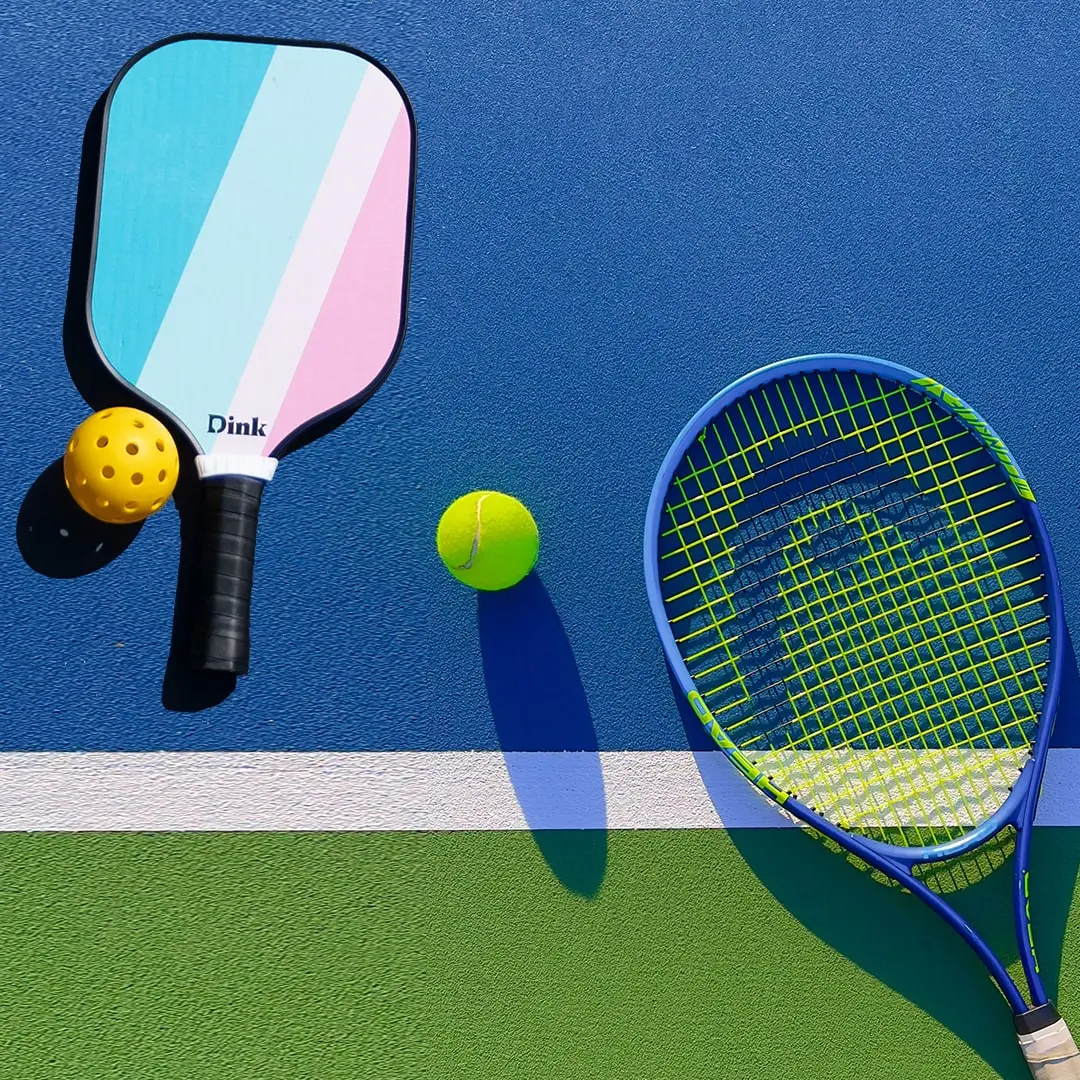
Padel rackets are solid, perforated, and slightly heavier, typically made from composite materials like fiberglass or carbon fiber. The paddle is shorter and thicker than a tennis racket and is designed to withstand the impact of hitting pressurized balls. Pickleball paddles are usually made from composite, fiberglass, and carbon fiber and do not have perforations. They are larger and more rectangular than padel rackets, making them easier to handle for beginners.
When it comes to balls, padel uses pressurized balls that are similar to tennis balls but slightly less bouncy, ensuring controlled play, especially when rebounding off the walls. Pickleball balls are made of hard plastic and feature perforations, much like a wiffle ball, and are designed for a low-bounce game on a smaller court. The ball’s lightweight and plastic structure in pickleball ensures quicker rallies and a different feel than padel’s heavier ball.
Design a Custom Pickleball Paddle to Make the Game More Enjoyable
Starting from $59.99/each
Court Differences
Padel and pickleball courts have notable differences in size, structure, and design, which affect the style of play. A padel court measures approximately 66 feet long by 33 feet wide and is enclosed by glass or mesh walls. These walls are integral to the game, allowing players to use them to rebound the ball during play. The court is divided by a net and is designed primarily for doubles matches.
In contrast, a pickleball court is smaller, measuring 44 feet long by 20 feet wide, with no enclosed walls, and the game can be played doubles formats. The net in pickleball stands 36 inches high at the sidelines and 34 inches at the center, slightly lower than a padel net. Pickleball courts feature a "non-volley zone" or "kitchen," which extends 7 feet from the net on both sides, prohibiting volleys within this area. Padel courts lack a similar zone, but the walls in padel offer more depth and strategic elements to the game.
Pickleball courts typically have a hard surface made of concrete or asphalt, while padel courts often use synthetic turf or sand-based surfaces to slow down the ball and provide more traction. These differences in court size, surface, and design lead to contrasting gameplay styles, with padel focusing on longer rallies and wall usage and pickleball emphasizing fast reflexes and net play.
Rules of Play
In padel, the scoring follows a tennis-like system, with games played to points such as 15, 30, and 40, and sets usually determined by a best-of-three format. Serves must be underhand, with the ball bouncing once before it is hit into the opposite service box.
A unique feature of pickleball is the "kitchen," where players cannot volley the ball, which forces strategic play around the net. Like in padel, the serve in pickleball must be underhand, but it is done diagonally, and the ball must bounce once on each side before volleys can begin. Games are typically played to 11 or 15/21 points, with a two-point lead required to win; pickleball scoring only occurs on the serve.
Paddle and Pickleball Accessibility
Padel is relatively easy to learn, especially for those with a background in tennis, as it shares similar rules and techniques. However, one challenge to padel's accessibility is the availability of courts. Padel courts are typically enclosed and require specific dimensions, which limits where the game can be played. In many regions padel courts are not as widely available, making it harder for new players to get involved.
Pickleball is known for being highly accessible and easy to pick up for people of all ages and at all levels of play. Its smaller court size and simplified rules make it less intimidating, even for complete beginners. Pickleball can be played on various surfaces, from tennis courts to gym floors, with the only major requirement being a net and a relatively flat surface. This adaptability, along with the growing popularity of pickleball in North America and beyond, has led to a significant increase in available courts. As a result, pickleball tends to be more accessible in terms of finding locations to play, making it a more practical option for many people.
Fitness and Health Benefits
Padel and pickleball offer significant fitness and health benefits, making them excellent choices for staying active. Padel provides a high-intensity cardio workout, focusing on endurance, agility, and quick reflexes. It helps to strengthen both the upper and lower body while placing less strain on joints compared to traditional tennis. This makes padel an effective full-body workout that enhances muscle tone and cardiovascular health.
Pickleball is especially beneficial for older players or those seeking a low-impact activity. It offers good cardiovascular exercise while improving coordination, balance, and reaction time. The smaller court size and slower pace of the game make it easier on the joints, making it accessible to a broader range of players, including those with mobility issues.
Both sports promote overall fitness, but pickleball is a slightly more accessible option for individuals concerned about joint strain or looking for a gentler introduction to racquet sports.
Popularity and Global Reach
Padel has become a sensation in Europe and Latin America, with countries like Spain, Argentina, and Portugal leading the way in terms of courts, players, and tournaments.
On the other hand, pickleball has its roots in the United States, where it has rapidly gained a following, particularly among older adults and in community settings. With its smaller courts, simplified rules, and quick learning curve, pickleball has become especially popular in North America, where many local parks, gyms, and clubs are now dedicating space to the sport. It is expanding globally as well, with countries in Europe, Asia, and Australia seeing a rise in dedicated pickleball communities and competitions.
Meet the Expert

Mike Hardy
Hey, I’m Mike Hardy, founder of Dink. I’ve spent years learning everything there is to know about what makes a paddle play great, and I personally test every single one we make (sometimes until they break) to make sure they’re up to the challenge. So, in my articles, I want to share my knowledge with you to help you find the perfect pickleball equipment for you.