In-Depth Review of the USAP Testing Process
Our article offers an in-depth review of the USAP testing procedures, exploring the technical standards and protocols that paddles must meet to receive certification.
The USA Pickleball Association (USAP) certification process ensures that paddles adhere to specific performance and safety criteria during tournaments, ultimately upholding the sport's competitive balance. The USAP testing standards involve comprehensive evaluations of factors such as deflection, roughness, and surface hardness, which are meticulously measured to guarantee that all certified paddles perform within the sport's regulations.
This guide aims to provide a detailed explanation of the testing procedures and an appreciation for the technical expertise.
Detailed Steps of Pickleball Paddles USAP Testing Process
The USAP testing process for pickleball paddles ensures that all equipment used in sanctioned play meets specific standards for fairness, performance, and safety during tournaments. This rigorous certification process is designed to maintain the integrity of the game by evaluating the paddles based on several critical factors. The steps involve a combination of laboratory testing and practical assessments, which are conducted to determine whether a paddle adheres to the official specifications set by USA Pickleball.
Design a Custom Pickleball Paddle to Make the Game More Enjoyable
Starting from $59.99/each
Submission and Preliminary Review
The testing involves a detailed evaluation to ensure that pickleball equipment, such as paddles, meets the official standards set by the governing body. Pickleball manufacturers must first submit their products along with a comprehensive set of documents, including technical specifications and a sample paddle, to undergo rigorous testing.
The preliminary review focuses on verifying the submission's completeness and initial compliance with USAP guidelines. During this phase, experts check the paddle’s dimensions, surface texture, weight, and other characteristics against established criteria. If the paddle passes the initial review, it proceeds to laboratory testing for more advanced assessments, such as deflection and coefficient of restitution.
Pickleball Paddle Sizing Testing
Pickleball paddle sizing is a crucial part of this certification, as it directly affects a player’s control, power, and overall performance on the court. The USAP testing process evaluates paddles based on dimensions, weight, and material. The paddle sizing test involves measuring paddles' length, widt to ensure they fall within the acceptable range set by the USAP. The length may not exceed 17” and the combined length and width may not exceed 24 inches, but there is no requirement for thickness.
Coefficient of Friction (COF) Testing
This test ensures that pickleball paddles meet the required surface roughness and friction standards, directly affecting gameplay, particularly the ability to impart spin on the ball. The COF test measures the interaction between the paddle surface and a standardized ball, simulating real play conditions to determine how much friction the paddle can generate.
Deflection Test
The primary goal of the deflection test is to assess how much a paddle deforms, or "deflects," when subjected to a controlled force. This test is important because it helps to determine the paddle's stiffness, which directly affects its performance, playability, and compliance with the rules of pickleball. A paddle that deflects too much might provide an unfair advantage by allowing greater power, hence the need for strict testing protocols.
During the deflection test, the paddle is placed on a testing apparatus, and a load of 3kg is applied to the center of the paddle's face. The amount of force applied and the resulting deflection are measured precisely to evaluate the paddle's compliance with USAP standards.
Reflection/Gloss Test
The focus is on the paddle's reflective and gloss characteristics, which can impact gameplay by affecting how the ball interacts with the paddle surface.
According to the USAP testing guidelines, paddles must not have excessively reflective surfaces that could distract players or interfere with fair play. The reflection test measures the light reflected off the paddle's surface under controlled lighting conditions. A paddle that reflects too much light may fail the test, as it can potentially cause glare on the court, which is considered unfair or unsafe for the players.
Similarly, the gloss test assesses the shininess or gloss level of the paddle's surface. The test uses a gloss meter, which measures the paddle's glossiness at specific angles, usually at 20, 60, and 85 degrees. The results are then compared against the allowable standards.
Surface Roughness Test
This test evaluates the texture of a pickleball paddle’s playing surface to ensure it falls within the acceptable range for competitive play. The goal is to prevent paddles with excessively rough surfaces that could give players an unfair advantage by generating spin on the ball.
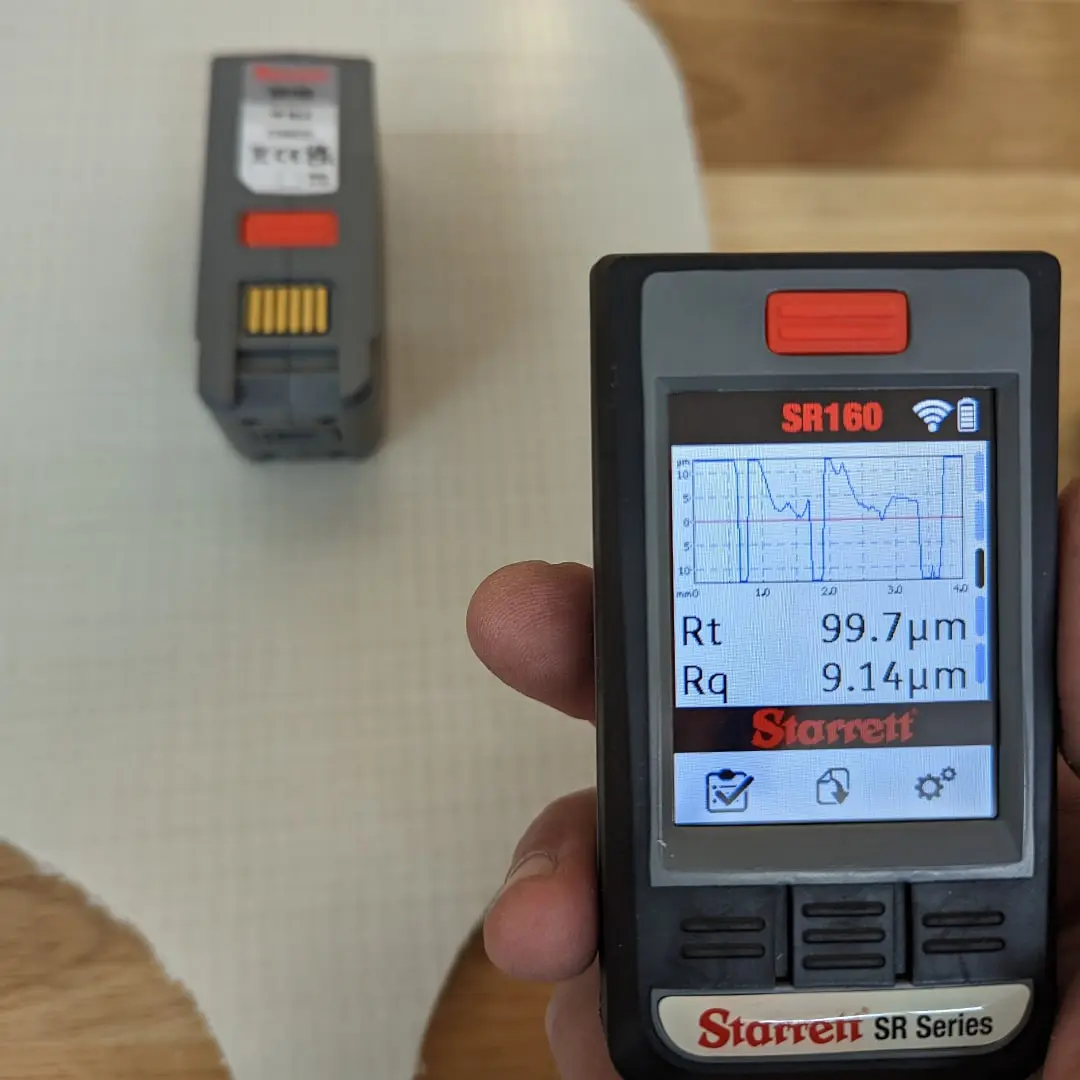
According to the USAP testing guidelines, the surface roughness is measured using a standardized method involving specialized equipment. The test uses a Starret Roughness Tester,, a device that precisely measures the texture of the paddle's surface to assess its roughness profile. The paddle's playing surface is scanned, and the profilometer analyzes the surface's peak-to-valley height.
Documentation and Reporting
Once the testing is completed, a detailed report is generated, summarizing the findings for each paddle. This report includes a comprehensive breakdown of the test results, highlighting whether the paddle meets, exceeds, or falls short of the required standards. Each parameter is meticulously documented, with results often supported by data from specialized testing equipment.
The report also includes sections for notes and observations, which provide additional context or explanations for any test failures or anomalies. If a paddle does not meet the certification criteria, the report will detail the specific areas of non-compliance, enabling manufacturers to make necessary modifications. Documentation is also kept on file to ensure traceability and maintain a historical record of the testing outcomes.
The reporting process is transparent and standardized, allowing manufacturers and stakeholders to understand the criteria used and the results obtained. Continuous updates to the testing standards and procedures are also documented to reflect any changes in the rules or technological advancements.
Common Reasons for Paddle Rejection
Pickleball paddles are often rejected for several common reasons.
One major cause of rejection is the paddle’s surface roughness. USAP has strict limits on how rough a paddle’s surface can be, as too much roughness can provide an unfair advantage by allowing players to impart excessive spin on the ball.
Another frequent reason for rejection is excessive deflection or the trampoline effect, where the paddle face has too much bounce, allowing for greater power and control that violates fair play standards.
The paddle's material composition is also a common reason for rejection.
If a paddle is made from non-approved materials or has an internal structure that deviates from the standard, it may not pass certification.
The core materials and outer layers must meet specific criteria to ensure consistent performance and durability.
Paddle thickness and size are other factors that can lead to rejection.
Paddles with surface treatments or coatings that alter the original playing characteristics might also be disqualified. This includes using non-standard paints or finishes that affect the ball's interaction with the paddle.
Manufacturing defects, such as inconsistencies in production, can also result in a paddle failing the certification process.
If the paddle has visible flaws or structural weaknesses that could impact performance or safety, it will be rejected.
Finally, alterations or modifications made after manufacturing, such as aftermarket attachments or enhancements, will lead to disqualification, as they can alter the paddle's original specifications.

Buy Your Mystery Paddle Right Now
$19.99
Common Deviations and Exceptions in Testing
The USA Pickleball (USAP) testing process is designed to ensure that all paddles meet the strict standards set by the organization. However, there are common deviations and exceptions that may occur during this process. For example, while the general requirement is that paddles are stored at controlled temperature and humidity for at least 24 hours before testing, this period can be shortened or omitted with prior approval, typically to expedite testing.
Another potential deviation involves the location and manner of testing certain paddle features, like the coefficient of friction (COF) and surface roughness. If a paddle has a non-uniform surface or specific features that could impact testing outcomes, the testing may focus on these unique areas rather than following the standard procedure of testing the center of the paddle.
While the testing procedure is standardized, variations in equipment calibration or environmental conditions may lead to minor deviations in results. Calibration intervals are strictly monitored, but equipment may perform slightly differently in some cases, necessitating re-calibration or additional testing to ensure accuracy.
Also, different parts of the paddle are tested during the deflection test to check for consistency. Still, minor variations in paddle construction may cause some deviation in results between different areas of the same paddle. These deviations and exceptions are accounted for in the overall assessment.
Equipment Required for Testing
The USAP paddle testing involves several key pieces of equipment to ensure that each paddle meets the official competition standards. A digital caliper or micrometer measures the paddle's dimensions, such as length, width, and thickness, ensuring they comply with the maximum allowed limits.
Surface roughness is another crucial aspect tested during the certification process. For this, a specialized surface roughness tester or profilometer is required to measure the texture of the paddle's hitting surface.
The paddle’s deflection and flexibility are also tested using a deflection testing rig, which assesses how much the paddle bends under pressure.
Meet the Expert

Mike Hardy
Hey, I’m Mike Hardy, founder of Dink. I’ve spent years learning everything there is to know about what makes a paddle play great, and I personally test every single one we make (sometimes until they break) to make sure they’re up to the challenge. So, in my articles, I want to share my knowledge with you to help you find the perfect pickleball equipment for you.